Oscoda County Dog Registration Information
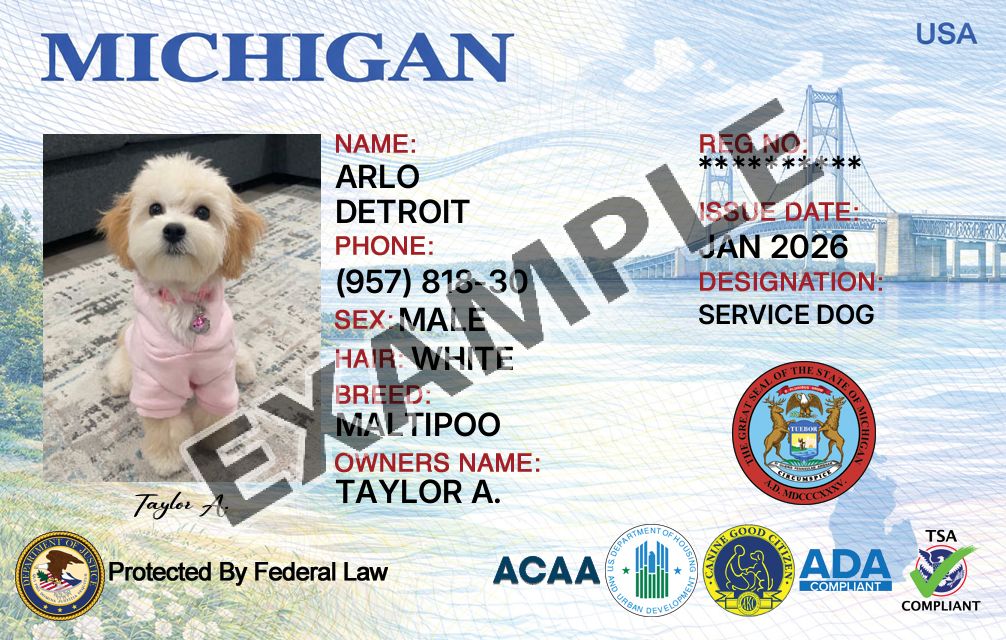
Service Dogs and Emotional Support Animals in Oscoda, Michigan
If you’re searching where do I register my dog in Oscoda County, Michigan for my service dog or emotional support dog, the answer usually starts in the same place: your local dog licensing office. In Oscoda County, a dog license in Oscoda County, Michigan is typically purchased through the Oscoda County Treasurer (and, during certain parts of the year, may also be available through participating township offices).
It’s also important to know that licensing a dog is not the same thing as establishing service dog legal status or qualifying an emotional support animal for housing accommodations. This page explains what to do locally, what paperwork you’ll likely need, and how to avoid common misunderstandings—especially around “registration” claims.
- A county dog license is a local animal control/public health tool tied to rabies vaccination and identification—this is often what people mean by “register my dog.”
- A service dog is defined by what the dog is trained to do (tasks/work related to a disability), not by a paid registry or online certificate.
- An emotional support animal (ESA) is primarily a housing accommodation category; it does not grant public-access rights like a service dog.
Where to Register or License Your Dog in Oscoda County, Michigan
Because licensing is handled locally, the most direct place to start when you’re asking where to register a dog in Oscoda County, Michigan is the county office that issues dog license tags. The offices below are official government or public-agency resources commonly involved in dog licensing, animal control, and rabies-related public health coordination within Oscoda County.
Primary Dog Licensing Office (Official)
| Office name | Oscoda County Treasurer |
|---|---|
| Street address | 311 S. Morenci Ave. |
| City / State / ZIP | Mio, MI 48647 |
| Phone | (989) 826-1113 |
| treasurer@oscodacountymi.com | |
| Office hours | Mon–Fri: 8:30 a.m.–4:30 p.m. (Closed for lunch 12–1 p.m.) |
This is the core answer for most residents looking for an animal control dog license Oscoda County, Michigan solution: start with the Treasurer’s office for license tags and current instructions.
Animal Control / Enforcement Contact (Official)
| Office name | Oscoda County Animal Control |
|---|---|
| Phone | (989) 745-1910 |
| Street address | Not listed in the cited county directory resources. |
| Not listed in the cited county directory resources. | |
| Office hours | Not listed in the cited county directory resources. |
Animal Control is typically involved in “at large” dogs, bite investigations, nuisance complaints, and enforcement issues where proof of licensing and rabies vaccination matters.
Law Enforcement Point of Contact (Official)
| Office name | Oscoda County Sheriff’s Office |
|---|---|
| Street address | 301 S. Morenci Ave. |
| City / State / ZIP | Mio, MI 48647 |
| Phone | (989) 826-3214 |
| sheriff@oscodacountymi.com | |
| Office hours | Not listed on the cited sheriff page. |
The Sheriff’s Office is the correct contact for emergencies (911) and many public safety situations. For service-animal-in-training disputes in public accommodations, Michigan guidance often directs complaints to local law enforcement.
Rabies / Public Health Contact (Official Public Health Agency)
| Office name | District Health Department No. 2 (Oscoda County Health Department – Mio Office) |
|---|---|
| Street address | 393 S. Mt. Tom Rd |
| City / State / ZIP | Mio, MI 48647 |
| Phone | (989) 826-3970 |
| healthed@dhd2.org | |
| Office hours | Mon–Thu: 8:00 a.m.–4:00 p.m.; Fri: 8:00 a.m.–3:30 p.m. (Lunch break noted by DHD2: 12:30 p.m.–1:00 p.m.) |
Licensing is tied to rabies vaccination documentation. If there’s an animal bite, rabies exposure concern, or you need public health guidance on reporting, the health department is a key local resource.
Example Township Office (Local Government)
| Office name | Mentor Township Office (Oscoda County) |
|---|---|
| Street address | 216 East 10th St |
| City / State / ZIP | Mio, MI 48647 |
| Phone | (989) 826-5414 |
| mentortownship@frontier.com | |
| Office hours | Township Treasurer (listed): Wednesday 9:00 a.m.–12:00 p.m. |
Oscoda County notes that dog licenses may be available at the Treasurer’s office and at some local township offices during certain times of year. If you prefer a local township counter service, call ahead to confirm participation and seasonal availability.
Overview of Dog Licensing in Oscoda County, Michigan
What “registering your dog” usually means
In everyday conversation, “registering” a dog in Michigan usually refers to getting a county-issued dog license tag. This is an official license associated with your dog’s rabies vaccination status and basic ownership information. If you’re trying to figure out where to register a dog in Oscoda County, Michigan, you’re typically looking for the office that issues these tags and records.
Oscoda County licensing basics
Oscoda County’s dog license guidance explains that owners must provide a current rabies certificate, plus proof of age, and (if applicable) proof the dog is spayed or neutered to obtain a license. The county also notes that, under state law, dogs must be licensed once they reach a specific age and that licenses are sold annually with an expiration at the end of the year.
Why licensing matters—even for service dogs and ESAs
Many people assume service dogs and emotional support animals do not need local licensing. In practice, licensing is about local animal regulation and rabies compliance. A service dog (or ESA) can still be subject to local dog licensing rules—because the license is not about “task training,” it’s about public health and local identification.
How Dog Licensing Works Locally in Oscoda County, Michigan
Step 1: Confirm where your license is issued (county vs. township)
Licensing is often handled locally, and Oscoda County indicates that dog licenses are available through the County Treasurer and, at certain times, some township offices. That’s why two residents living in different townships may hear slightly different instructions. If your question is specifically, “where do I register my dog in Oscoda County, Michigan,” start with the Treasurer’s office and ask whether your township also issues licenses seasonally.
Step 2: Gather your documentation
The standard documents typically include your dog’s current rabies certificate, plus proof of the dog’s age, and proof of spay/neuter (if applicable). If you’re applying for a lower altered-dog rate (when offered), spay/neuter proof is commonly required. Keep copies for your records.
Step 3: Purchase and renew annually
Oscoda County sells dog licenses on an annual basis with a year-end expiration. The county also describes discounted early-purchase periods and standard fee periods. Many residents choose to renew at the same time each year, often aligned with rabies vaccination documentation timing.
Step 4: Use the right office for the right issue
Licensing / tags / fees
Use the Treasurer (or a participating township office) when you need to purchase or renew your dog license in Oscoda County, Michigan, update ownership info, or ask what proof is required.
Bites / rabies exposure / public health reporting
Contact the local health department for rabies-related public health questions and reporting guidance, especially after an animal bite or potential exposure.
Rabies vaccination requirements (why they’re central to licensing)
In Michigan, proof of current rabies vaccination is commonly required to obtain a dog license, and local government (village/township/city/county) has jurisdiction over dog licensing and tag issuance. Rabies titers are not treated as a substitute for vaccination for licensing purposes in Michigan guidance intended for veterinary/public health practice. This is why nearly every licensing transaction starts with the rabies certificate.
Service Dog Laws in Oscoda County, Michigan
Service dog vs. dog license: two different systems
A dog license is a local registration/tag process related to rabies vaccination and identification. A service dog is a legal category under disability law based on the dog being individually trained to perform work or tasks for a person with a disability. In other words: licensing answers “Is the dog properly licensed for the county?” while service dog law answers “Does the dog have public-access rights because it performs trained tasks related to a disability?”
Public access and the “two questions” concept
Under ADA-based guidance commonly used in Michigan, when it’s not obvious that a dog is a service animal, staff may generally ask two questions: (1) whether the dog is required because of a disability and (2) what work or task the dog has been trained to perform. This does not require you to disclose your diagnosis, and it does not rely on a purchased “registration.”
Service animals in training in Michigan
Michigan has specific provisions recognizing access for service animals in training in places of public accommodation when accompanied by a trainer/raiser for training or socialization. If you run into a public-access issue involving a service animal in training, Michigan guidance notes that complaints may be directed to local law enforcement.
Voluntary identification is not required
Michigan offers a voluntary service animal identification program through the Michigan Department of Civil Rights (MDCR). Voluntary identification may be helpful for convenience, but it cannot be required as a condition of entry, and it does not replace the underlying legal definition of a trained service animal.
Emotional Support Animal Rules in Oscoda County, Michigan
ESA vs. service dog vs. pet
An emotional support animal (ESA) is not the same as a service dog. An ESA generally provides therapeutic emotional support that alleviates one or more symptoms or effects of a disability, but ESAs are not required to be trained to perform specific tasks the way a service dog is. Because of that, ESAs typically do not have the broad public-access rights that service dogs do (for example, to enter restaurants or grocery stores as a matter of disability access law).
Where ESA status matters most: housing
ESAs are most often addressed through housing accommodations (commonly discussed under the Fair Housing Act framework). In housing, an ESA request is usually treated as a reasonable accommodation request related to disability, and the documentation focus is typically on the disability-related need for the animal—not on a paid “registration.”
Licensing still applies locally
Even if your dog is an ESA, local rules for rabies vaccination and licensing can still apply. That means if you’re asking “where do I register my dog in Oscoda County, Michigan for my service dog or emotional support dog,” you still generally start with the local licensing office for the county-issued tag and keep your rabies documentation current.
Frequently Asked Questions
Usually, yes. A local dog license is about rabies compliance and local identification, not about whether your dog is trained for disability-related tasks. If you’re trying to confirm requirements for your exact situation (including any fee rules that may apply), contact the Oscoda County Treasurer.
Oscoda County’s licensing guidance indicates you should be prepared with:
- Current rabies certificate
- Proof of age
- Proof of spay/neuter (if applicable)
No paid registry is required to make a dog a service dog. Service dog status is based on the dog being individually trained to do work or perform tasks for a person with a disability. Michigan also provides voluntary identification through MDCR, but it is not required as a condition of entry.
Start with the Oscoda County Treasurer for county-issued licensing. Oscoda County also notes that some township offices may issue licenses during certain periods; because participation can vary, call your township office or the Treasurer first to confirm availability and hours.
Generally, no. ESAs are typically handled as housing accommodations and do not have the same broad public-access rights as service dogs under disability access rules. If you need help with housing documentation, you may want to consult a qualified healthcare provider and review housing accommodation policies.
Licensing requirements and office locations may change. Residents should verify details with their local animal services office within Oscoda County, Michigan.
Register A Dog In Other Michigan Counties
Select your county below to get started with your dog’s ID card. Requirements and license designs may vary by county, so choose your location to see the correct options and complete your pup’s registration.
- Alcona County Dog Registration
- Alger County Dog Registration
- Allegan County Dog Registration
- Alpena County Dog Registration
- Antrim County Dog Registration
- Arenac County Dog Registration
- Baraga County Dog Registration
- Barry County Dog Registration
- Bay County Dog Registration
- Benzie County Dog Registration
- Berrien County Dog Registration
- Branch County Dog Registration
- Calhoun County Dog Registration
- Cass County Dog Registration
- Charlevoix County Dog Registration
- Cheboygan County Dog Registration
- Chippewa County Dog Registration
- Clare County Dog Registration
- Crawford County Dog Registration
- Delta County Dog Registration
- Dickinson County Dog Registration
- Eaton County Dog Registration
- Emmet County Dog Registration
- Genesee County Dog Registration
- Gladwin County Dog Registration
- Gogebic County Dog Registration
- Grand Traverse County Dog Registration
- Gratiot County Dog Registration
- Hillsdale County Dog Registration
- Houghton County Dog Registration
- Huron County Dog Registration
- Ingham County Dog Registration
- Ionia County Dog Registration
- Iosco County Dog Registration
- Irom County Dog Registration
- Isabella County Dog Registration
- Jackson County Dog Registration
- Kalamazoo County Dog Registration
- Kalkaska County Dog Registration
- Kent County Dog Registration
- Keweenaw County Dog Registration
- Lake County Dog Registration
- Lapeer County Dog Registration
- Leelanau County Dog Registration
- Lenawee County Dog Registration
- Livingston County Dog Registration
- Luce County Dog Registration
- Mackinac County Dog Registration
- Macomb County Dog Registration
- Manistee County Dog Registration
- Marquette County Dog Registration
- Mason County Dog Registration
- Mecosta County Dog Registration
- Menominee County Dog Registration
- Midland County Dog Registration
- Missaukee County Dog Registration
- Monroe County Dog Registration
- Montcalm County Dog Registration
- Montmorency County Dog Registration
- Muskegon County Dog Registration
- Newaygo County Dog Registration
- Oakland County Dog Registration
- Oceana County Dog Registration
- Ogemaw County Dog Registration
- Ontonagon County Dog Registration
- Osceola County Dog Registration
- Otsego County Dog Registration
- Ottawa County Dog Registration
- Presque Isle County Dog Registration
- Roscommon County Dog Registration
- Saginaw County Dog Registration
- Sanilac County Dog Registration
- Schoolcraft County Dog Registration
- Shiawassee County Dog Registration
- St. Clair County Dog Registration
- St. Joseph County Dog Registration
- Tuscola County Dog Registration
- Van Buren County Dog Registration
- Washtenaw County Dog Registration
- Wayne County Dog Registration
- Wexford County Dog Registration